CARONTE
Swap Arbitrage
Cross-Broker Carry Engineering — Swap, Hedge, Margin Survival & Execution Control
$1,200
Mission and vision
Mission
Design, formalise, implement, and validate a delta-neutral cross-broker carry system that measures financing, exposure, margin survival, execution, costs, and contractual risk before live data or live capital.
Vision
Traders who can build a quantitative research engine for cross-broker carry, governed by invariants of exposure, accounting, margin, execution, and survival — not a swap recipe, and not a free-lunch slide.
Why CARONTE
CARONTE is Swap Arbitrage — Cross-Broker Carry Engineering. It is not ZEUS, not AQUILES, not HEFESTO, and not Kratos. It is not a slide about “free lunch.”
The object is a delta-neutral cross-broker carry system: observable financing dispersion, a vector hedge, margin survival, accounting integrity, execution reconciliation, stress validation, and contractual eligibility. Formation uses mock and synthetic data. Evaluation with live brokers is a later, separate phase.
A strategy that is economically neutral can still blow one of its accounts before the aggregated hedge has a chance to prove it was neutral.
Who it is for
Algorithmic traders, independent quants, trading-system developers, market-neutral researchers, and FX/CFD systematic operators. Python, bid/ask, leverage and margin, realised/unrealised P&L, and basic backtesting are assumed.
What it is not
Not “find the highest swap.” Not lot-equal coverage as a hedge. Not copy-paste signals. Not a profit promise. Lecture bodies are not authored yet.
What you'll be able to do
- Separate observable GrossCarry from markup, financing stories, and commercial swap promotions
- Normalise heterogeneous broker specs into a canonical contract before they enter the core
- Hedge by currency exposure E(c,t) — not by matching lots — and name the residual
- Model first-passage stop-out T_SO and size to survival, not to hoped-for carry
- Keep Gate A (the engine works on mock) distinct from Gate B (whether the strategy exists)
Course map
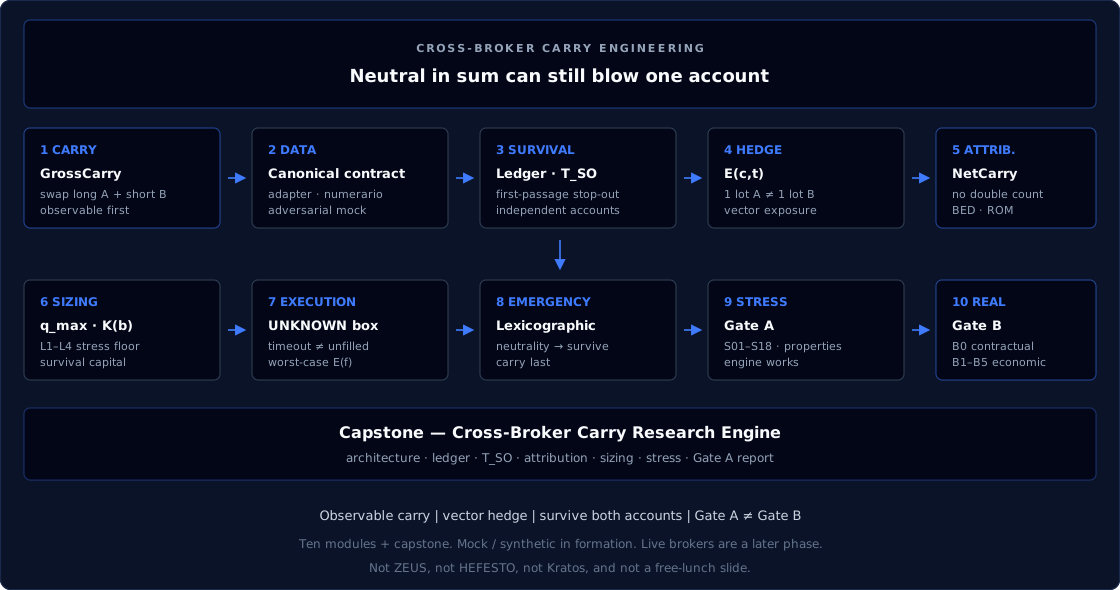
Same path as the accordion below. Ten technical phases, ten modules, one capstone. Not a free-lunch slide.
Course content
Phase 1 — CARRY
Module 1 — Economy of Swap and Cross-Broker Carry
Phase 2 — DATA
Module 1 — Broker Data Engineering and Normalisation
Module 2 — Mock Market Generator and Structural Consistency
Phase 3 — SURVIVAL
Module 1 — Ledger, Equity and System Accounting
Module 2 — Margin Survival Engineering
Phase 4 — HEDGE
Module 1 — Hedge Engineering and Vector Exposure
Phase 5 — ATTRIBUTION
Module 1 — P&L Attribution and Carry Metrics
Phase 6 — SIZING
Module 1 — Robust Sizing and Capital Allocation
Phase 7–8 — EXECUTION · EMERGENCY
Module 1 — Execution Uncertainty and Emergency Control
Phase 9–10 — STRESS · REAL
Module 1 — Stress Laboratory, Gate A and Mock-to-Real
Capstone — Cross-Broker Carry Research Engine
Course content is Phase → Module → Chapter using CARONTE's technical phases. Module numbers restart inside each phase. Modules IX and X each span two roadmap phases as authored (7–8 EXECUTION / EMERGENCY; 9–10 STRESS / REAL). The capstone sits outside the ten phases. Lecture bodies are not authored yet.
Instructor

Elmer Niño
Founder, VTAlgo Group · Systems Engineer · MSc in Computer Science
Algorithmic trader since 2008, running trading as an enterprise. Methodology built on walk-forward analysis, genetic optimization, PCA against over-optimization, the Triple Barrier Method, and 9–12 month live validation before capital.
CARONTE
Arbitraje Swaps
Cross-Broker Carry Engineering — Swap, Hedge, Margin Survival & Execution Control
$1,200
Misión y visión
Misión
Diseñar, formalizar, implementar y validar un sistema de carry cross-broker con cobertura delta-neutral, capaz de medir financiación, exposición, supervivencia de margen, ejecución, costes y riesgo contractual antes de usar datos o capital reales.
Visión
Traders que puedan construir un motor de investigación cuantitativa para carry cross-broker, gobernado por invariantes de exposición, contabilidad, margen, ejecución y supervivencia — no una receta de swap, y no una diapositiva de almuerzo gratis.
Por qué CARONTE
CARONTE es Arbitraje Swaps — Cross-Broker Carry Engineering. No es ZEUS, no es AQUILES, no es HEFESTO, y no es Kratos. No es una diapositiva sobre “almuerzo gratis.”
El objeto es un sistema de carry cross-broker con cobertura delta-neutral: dispersión observable de financiación, cobertura vectorial, supervivencia de margen, integridad contable, reconciliación de ejecución, validación de estrés y elegibilidad contractual. La formación usa datos mock y sintéticos. La evaluación con brokers reales es una fase posterior y separada.
Una estrategia económicamente neutral puede quebrar una de sus cuentas antes de que la cobertura agregada tenga oportunidad de demostrar que era neutral.
A quién va dirigido
Traders algorítmicos, quants independientes, desarrolladores de sistemas de trading, investigadores de estrategias market-neutral y operadores sistemáticos de FX/CFD. Se asume Python, bid/ask, apalancamiento y margen, P&L realizado/no realizado y backtesting básico.
Qué no es
No es “buscar el swap más alto.” No es una cobertura por igualdad de lotes. No son señales para copiar. No es una promesa de rentabilidad. Los cuerpos de lección aún no están escritos.
Lo que vas a poder hacer
- Separar el GrossCarry observable del markup, las historias de financiación y las promociones comerciales de swap
- Normalizar especificaciones heterogéneas de brokers a un contrato canónico antes de que entren al núcleo
- Cubrir por exposición de divisa E(c,t) — no por igualdad de lotes — y nombrar el residual
- Modelar el stop-out de primer paso T_SO y dimensionar a supervivencia, no al carry esperado
- Mantener Gate A (el motor funciona en mock) distinto de Gate B (si la estrategia existe)
Mapa del curso
El mismo recorrido que el acordeón de abajo. Diez fases técnicas, diez módulos, un capstone. No es una diapositiva de almuerzo gratis.
Contenido del curso
Phase 1 — CARRY
Module 1 — Economy of Swap and Cross-Broker Carry
Phase 2 — DATA
Module 1 — Broker Data Engineering and Normalisation
Module 2 — Mock Market Generator and Structural Consistency
Phase 3 — SURVIVAL
Module 1 — Ledger, Equity and System Accounting
Module 2 — Margin Survival Engineering
Phase 4 — HEDGE
Module 1 — Hedge Engineering and Vector Exposure
Phase 5 — ATTRIBUTION
Module 1 — P&L Attribution and Carry Metrics
Phase 6 — SIZING
Module 1 — Robust Sizing and Capital Allocation
Phase 7–8 — EXECUTION · EMERGENCY
Module 1 — Execution Uncertainty and Emergency Control
Phase 9–10 — STRESS · REAL
Module 1 — Stress Laboratory, Gate A and Mock-to-Real
Capstone — Cross-Broker Carry Research Engine
Course content is Phase → Module → Chapter using CARONTE's technical phases. Module numbers restart inside each phase. Modules IX and X each span two roadmap phases as authored (7–8 EXECUTION / EMERGENCY; 9–10 STRESS / REAL). The capstone sits outside the ten phases. Lecture bodies are not authored yet.
Instructor
Elmer Niño
Fundador, VTAlgo Group · Ingeniero de Sistemas · MSc en Ciencias de la Computación
Trader algorítmico desde 2008, que lleva el trading como una empresa. Metodología construida sobre walk-forward analysis, optimización genética, PCA contra la sobreoptimización, el Triple Barrier Method y 9–12 meses de validación en vivo antes de poner capital.